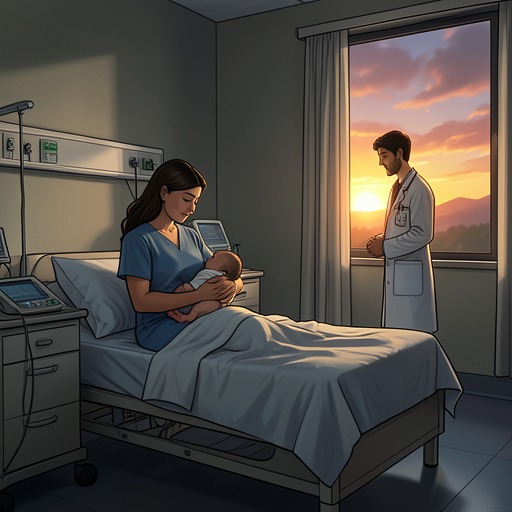
Miraculous healing of the newborn girl
Don't Leave God Alone: How to Get God's Attention, Remain in His Presence, and Even Change His Mind to Make a Difference in Your WorldThe miraculous healing of the newborn girl is a church-centered account of medical crisis and claimed divine intervention. A newborn whose blood-platelet count was dangerously low, whose liver was failing, and whose doctors gave her only an 11 percent chance of living is presented as being restored after sustained prayer, a decisive act of faith, and an encounter described as the manifestation of God's power.
Medical Crisis and Human Stakes
The crisis began with the child's diagnosis of an incurable disease affecting her liver and blood. Her platelet count was extremely low, and the doctors were deeply concerned that she might not survive. The medical prognosis established the severity of the situation in numerical terms: the infant had only an 11 percent chance of living. The diagnosis therefore functions not merely as background information but as the measurable limit against which the later testimony of healing is set.
The church's prayer did not produce an immediate visible change. The congregation rose up to pray, yet for days the child's condition continued to worsen, while she lay almost lifeless in an incubator. The delay is crucial to the event's religious interpretation. Rather than treating the absence of rapid improvement as a conclusion, Hank Kunneman compares the situation to Elisha's uncertainty about whether God's power would remain with him after Elijah's departure. The family and congregation continued speaking God's promises of healing despite the discouraging medical outlook.
The Decision to Persist
The turning point first occurs as a decision within Hank Kunneman and then becomes a shared resolve among the child's parents and other believers. He determined that the situation was not right and that God would perform a miracle; the parents and others adopted the same determination. In the account, this resolve displaced their earlier fear and shock. The desired healing was not described as the result of a single effortless moment, but as the outcome of refusing to abandon the pursuit of divine power while the evidence continued to look unfavorable.
The narrative connects this resolve to the pattern of Elisha following Elijah through four places of testing, identified as Gilgal, Bethel, Jericho, and Jordan. Those stages are presented as forming the backbone of the believers' ability to hold on to God's power. In this framework, the infant's illness becomes a contemporary test of commitment: prayer, endurance, obedience, and spiritual determination are treated as preparation for receiving and using healing power rather than as responses reserved for a crisis's final moment.
The Hospital Encounter
On the following Sunday morning, Hank Kunneman reports hearing the Holy Spirit instruct him to rock the baby in a chair. He understood the instruction as coming from God, contacted the parents, and arranged permission to hold the child. On the way to the hospital, he thanked the Lord for His power and became convinced that something had shifted spiritually.
At the hospital, he rocked the infant under what he calls the anointing and felt the power of God. The account does not emphasize an elaborate prayer or a dramatic public performance. Instead, the action is physically simple: he held and rocked the child, then said, “Lord, You have healed this baby, now let Your power manifest.” The scene turns bodily care into a ritualized act of faith, joining touch, spoken declaration, pastoral authority, and the expectation that healing would become visible.
Reported Healing and Aftermath
The next day, the doctors were reportedly amazed by the baby's blood-platelet count and by significant changes in her condition. She suddenly began to improve. The account concludes that she became a healthy and adorable little girl, described as full of God's life. The medical crisis thus moves from a prognosis of near death to a testimony of recovery, with the change presented as miraculous rather than as an ordinary clinical improvement.
The event's immediate consequence is not only the child's survival but also the reinforcement of the church's confidence in persistent prayer. Hank Kunneman interprets the result as proof that the believers had decided they had to have God's power and would pursue it until they found it. The healing is therefore made to answer the earlier silence and deterioration: what appeared to be divine disregard is re-read as a period in which determination was being formed.
Narrative and Theological Significance
The newborn girl's healing occupies the book's recurring pattern of crisis, continued appeal, breakthrough, testimony, and exhortation. Its force comes from the contrast between the 11 percent medical estimate and the later description of a healthy child, and from the contrast between days of worsening illness and the reported improvement after the hospital visit. The story also echoes other episodes in which prayer is maintained through apparent nonresponse: Paul and Silas praise God at midnight before the prison earthquake, and Elijah prays seven times before a small cloud becomes the sign of abundant rain.
Within this framework, the child is less an individualized speaking character than the embodied center of a communal testimony. Her condition mobilizes parents, church members, and a pastor; her recovery is then used to teach that believers should not stop pursuing God when circumstances deteriorate. The account presents the healing as a decisive sign of God's power, while its practical narrative depends on the cooperation of medical care, family involvement, congregational prayer, and pastoral action. Its lasting meaning in the book lies in that combination: the infant's recovery becomes evidence for a theology of persistence and an invitation to continue seeking divine intervention in the face of seemingly final diagnoses.